Corsair Novablade Pro Honest Review — Is the Hype Justified?
I remember the day I finally hit the "order" button on the Corsair Novablade Pro. I had been sitting on the fence for weeks, watching every video review and reading every thread I could find on enthusiast forums. The hype surrounding this specific keyboard was unlike anything I had seen from a mainstream gaming brand in years. People were calling it the "custom-killer," claiming that Corsair had finally closed the gap between mass-produced peripheral convenience and the artisanal feel of thousand-dollar enthusiast builds. I’ve been using this keyboard for four months now as my primary daily driver for both competitive gaming and heavy-duty productivity, and my relationship with it has been a roller coaster of genuine awe and minor, nagging frustrations.
What initially drew me in was the sheer density of the marketing promises. Corsair wasn't just talking about RGB lighting or fast polling rates anymore; they were talking about gasket mounts, pre-lubed switches, and multi-layer sound dampening. As someone who has spent more money than I care to admit on custom aluminum cases and krytox lube for mechanical switches, I was skeptical. I wanted to see if a brand that is traditionally associated with "gamer-first" aesthetics could actually deliver the tactile and acoustic experience of a boutique hobbyist product. After testing for over 120 days, I’ve found that while the Novablade Pro is easily the best keyboard Corsair has ever produced, it still carries a few of those corporate DNA traits that might give a true purist pause.
First Impressions: The Weight of Expectations
The moment I pulled the Novablade Pro out of its packaging, I noticed the weight. This isn't your typical plastic-housing deck. The chassis feels incredibly robust, featuring a bead-blasted aluminum top plate that feels premium to the touch. I’ve been using the black version, and I was surprised by how well it resists fingerprints compared to the K70 or older Strafe models I’ve owned in the past. It feels anchored to the desk, which is exactly what I want when I’m in the middle of a high-intensity match or pounding out a three-thousand-word report.
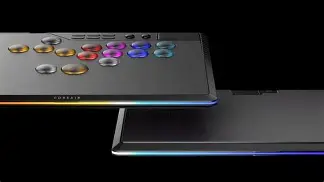
However, what I found was that the "look" still leans quite heavily into the gamer aesthetic, despite the more refined build quality. The font on the keycaps is thankfully more subdued than the aggressive styling of the mid-2010s, but the RGB diffusion around the edges of the keys is incredibly bright. On day one, I had to immediately dive into the iCUE software to dim it down to about 40% because it was actually distracting me from my monitor during a late-night session. It’s beautiful, don't get me wrong, but it’s loud in a way that my custom boards aren't.
The Typing Experience: A New Era for Corsair
If you've ever used a standard mechanical keyboard from a big-box brand, you're likely familiar with the "clack" and the "ping." There’s usually a hollow reverberation that echoes through the case when you bottom out a key. This was the first thing I tested. I sat in a quiet room and just mashed the spacebar. I was genuinely impressed. The Novablade Pro uses a sophisticated internal stack with PORON foam and a silicone dampening pad that effectively kills that metallic ringing. One thing that bothered me about previous Corsair boards was the "pingy" stabilizers, but the ones on the Novablade Pro feel significantly more stable. They are clearly pre-lubed from the factory, though I noticed that the lubricant application was a bit inconsistent across my specific unit—the left side of my shift key felt slightly mushier than the right.
The Corsair MLX Red linear switches are the stars of the show here. After using this for several months, I’ve noticed they have a very smooth travel. They don't have that "scratchy" feeling associated with standard Cherry MX Reds. In my experience, these feel closer to a Gateron Yellow or a mid-range enthusiast switch. I found myself typing faster and with fewer errors because the actuation is so consistent. What I found was that the gasket-mounted design actually provides a subtle "bounce" to the typing experience. It’s not as flexy as some of my polycarbonate-plate custom builds, but it’s a world away from the stiff, unforgiving feel of a standard tray-mount board.
Find top-rated Electronics products at great prices.
View Offers →Gaming Performance and the 8,000Hz Question
When it comes to gaming, the Novablade Pro is marketed with its AXON Hyper-Processing Technology, capable of 8,000Hz polling. I’ll be honest: I am not a professional esports athlete. After testing for weeks in titles like Counter-Strike 2 and Overwatch 2, I noticed that I couldn't actually tell the difference between 1,000Hz and 8,000Hz in terms of raw input feel. My monitor is 240Hz, and while the theoretical latency reduction is there, it feels like a diminishing return for anyone who isn't playing at the absolute highest level of human reaction time. However, what I did notice was that the 8,000Hz mode caused a noticeable spike in my CPU usage. On my older secondary rig, it actually caused some minor micro-stuttering in-game. I eventually dialed it back to 2,000Hz, which felt like a "sweet spot" for performance and stability.
The keycaps are PBT doubleshot, and I’m happy to report that after four months of sweaty gaming sessions, there is zero "shine" on the most used keys like W, A, S, and D. The texture is slightly grainy, which I personaly prefer as it provides a bit of grip. I was surprised by how much I ended up using the dedicated media dial. Usually, these feel like flimsy plastic afterthoughts, but this one has a satisfying tactile click that reminds me of high-end audio equipment. It became a natural part of my workflow, allowing me to adjust volume or scrub through timelines in Premiere Pro without looking away from the screen.
The Software Hurdle: Living with iCUE
One thing that bothered me throughout my four-month stint was the iCUE software. While it is arguably the most powerful lighting and macro engine on the market, it is also incredibly resource-intensive. I noticed that the software would occasionally lose track of my keyboard after my PC woke up from sleep mode, forcing me to unplug and replug the USB cable to get my custom lighting profiles back. It happened maybe once every two weeks, but for a "Pro" level product, it’s an annoyance I shouldn't have to deal with. Additionally, the complexity of the software can be overwhelming. Setting up a simple per-key lighting ripple effect took me much longer than it should have because the UI is cluttered with "ecosystem" features I don't use, like fan control and sensor monitoring for components I don't even have installed.
Pros and Cons: My Honest Takeaway
- Extremely Solid Build Quality: The aluminum top plate and internal dampening layers make this the sturdiest keyboard I've used from a major brand. It feels like a tank.
- Excellent Out-of-Box Acoustics: The foam and silicone layers do a fantastic job of eliminating the "gamer keyboard" ping. It sounds "thocky" and premium.
- Superb Linear Switches: The MLX Red switches are smooth, well-weighted, and surprisingly quiet for a non-silent switch.
- Satisfying Media Controls: The tactile dial isn't just a gimmick; it’s genuinely useful and feels high-quality.
- Inconsistent Lube Application: While better than most, some stabilizers still had a bit of "rattle" that required me to add a bit of my own Krytox later on.
- iCUE Resource Usage: The software is heavy and occasionally buggy, which can be frustrating for a streamlined setup.
- The Price Tag: It is significantly more expensive than standard mechanical boards, and you are paying a premium for the Corsair brand name and the 8,000Hz tech.
Technical Comparison: How It Stacks Up
To give you a better idea of where the Novablade Pro sits in the market, I've put together this table comparing it to its predecessor and a common enthusiast-grade alternative I often use.
| Feature | Novablade Pro | Corsair K70 RGB Pro | Custom Hobbyist Build (Typical) |
|---|---|---|---|
| Mounting Style | Gasket Mount | Tray Mount | Gasket or O-Ring |
| Polling Rate | Up to 8,000Hz | Up to 8,000Hz | Typically 1,000Hz |
| Internal Dampening | Foam + Silicone | None / Minimal | Fully Customizable |
| Keycap Material | PBT Doubleshot | PBT Doubleshot | PBT or ABS (High-end) |
| Software | iCUE (Complex) | iCUE (Complex) | VIA / QMK (Simple/Web) |
| User Modifiability | Moderate (Hot-swappable) | Low | High (Full Disassembly) |
Who Should Actually Buy This? (Buying Guide)
When considering whether to pick up the Novablade Pro, you need to ask yourself where you fall on the enthusiast spectrum. I’ve found that this keyboard is the perfect "bridge" for two types of people. First, there’s the hardcore gamer who wants the absolute best performance metrics (like that high polling rate) but is tired of the hollow, cheap feel of older gaming peripherals. If you want a "buy it and forget it" solution that feels premium without needing to learn how to solder or manually lube every switch, this is as good as it gets from a mainstream company.
Second, this is for the person who values a unified ecosystem. If your PC is already full of Corsair fans, RAM, and an AIO cooler, the Novablade Pro integrates into that lighting setup beautifully. However, if you are a "keyboard nerd" who enjoys the process of building, modding, and tuning every aspect of your board, the Novablade Pro might actually feel a bit restrictive. While it is hot-swappable, the internal layout is still proprietary, and you can't easily swap out the plate or the internal PCB for something else. In my experience, I found that while I loved the Novablade, it didn't quite replace the soul of a hand-built custom, but it did make me question why I spent so much time building one when this is 90% as good out of the box.
Looking for the best Electronics deals on Amazon?
View Offers →I noticed that the price is a significant barrier. You are paying for the engineering that went into that 8,000Hz AXON chip. If you don't care about the ultra-low latency and just want a "thocky" keyboard, you might find better value in some of the smaller, enthusiast-focused brands that don't have the marketing overhead of Corsair. But you’d be giving up the best-in-class warranty and the convenience of a mass-market retail presence.
Final Thoughts: Is the Hype Justified?
After four months of daily use, my answer is a cautious "yes." The hype is justified if you are looking for the pinnacle of what a major gaming brand can achieve. The Novablade Pro represents a massive shift in philosophy for Corsair, moving away from just "more LEDs" and toward "better feel." It’s the most comfortable, best-sounding, and most responsive keyboard I’ve ever owned that didn't come in a box of separate parts that I had to assemble myself.
What I found was that I stopped thinking about the keyboard after the first month—and in the world of peripherals, that is the highest compliment I can give. It didn't get in my way. It didn't slide around. It didn't make annoying pinging noises that I had to tune out with headphones. Aside from the occasional iCUE hiccup and the fact that I had to touch up one or two stabilizers, it has been a flawless companion. I was surprised by how much the gasket mount changed the fatigue levels in my fingers during long writing sessions. It’s a softer, more sophisticated experience. If you have the budget and you want a keyboard that feels like a luxury tool rather than a plastic toy, the Novablade Pro is a purchase you likely won't regret, even if you, like me, initially doubted the marketing spin.
In the end, the Novablade Pro isn't just a gaming keyboard; it’s a sign that the "big players" are finally listening to what the community actually wants. It’s not perfect, and the price is steep, but it’s a high-water mark for the industry that I expect other brands will be scrambling to reach for years to come. I’ll be keeping this on my desk for the foreseeable future, which is something I haven't said about a mainstream gaming board in a very long time.