I Tested the Ecotank Et 3950 for a Month: Here is My Verdict
The landscape of home office equipment has shifted dramatically over the last few years, moving away from the disposable hardware model toward sustainable, long-term investments. Perhaps no category exemplifies this change more than the inkjet printer. For decades, the industry relied on the "razor and blades" business model, where the hardware was sold at a loss or thin margin, while the replacement ink cartridges cost a small fortune. The Epson EcoTank ET-3950 represents a departure from that legacy, utilizing a high-capacity ink tank system designed to eliminate the anxiety of running out of ink mid-task. After thirty days of rigorous testing in a high-demand home office environment, this article provides a comprehensive analysis of whether this mid-range supertank printer lives up to the hype and its premium price tag.
Introduction to the EcoTank Ecosystem
The Epson EcoTank ET-3950 is positioned as a versatile, all-in-one cartridge-free solution for home offices and small workgroups. Unlike traditional printers that use plastic cartridges containing a few milliliters of ink, the ET-3950 features large, integrated front-facing tanks. These tanks are refilled using keyed bottles that ensure a mess-free process. The value proposition is simple: pay more upfront for the hardware to save significantly on operating costs over the life of the machine. In a month of testing, the primary goal was to determine if the print quality, software reliability, and mechanical durability justified the initial expenditure, which is often three to four times higher than a comparable cartridge-based printer.
This specific model sits in a "sweet spot" within Epson’s lineup. It offers more robust features than the entry-level 2000-series models—such as an auto-document feeder and faster print speeds—without reaching the enterprise-level price points of the 5000 or 8000 series. For the average professional working from home or a student with high-volume printing needs, the ET-3950 aims to be the only printer they will need for several years.
Design and Build Quality
The first impression of the ET-3950 is its surprisingly compact footprint. Despite housing four large ink reservoirs and an automatic document feeder (ADF), it takes up less desk real estate than many traditional office printers. The matte black finish is professional and resistant to fingerprints, while the front-facing tanks allow for easy monitoring of ink levels at a glance. There is no need to navigate software menus to see if you are running low; the physical windows on the front provide immediate visual feedback.
The control panel features a 2.4-inch color display. While it is not a touchscreen, the navigation buttons are tactile and responsive. The interface is intuitive, though users accustomed to smartphone-like touch interfaces might find the directional pad navigation slightly dated. However, for a device intended for utility, the physical buttons often prove more durable and less prone to input errors in a busy office setting.
Paper handling is managed by a 250-sheet front-loading tray. This is a significant upgrade over entry-level models that often use small rear-loading slots. A 250-sheet capacity means a full half-ream of paper can be loaded at once, reducing the frequency of refills. The top-mounted ADF can handle up to 30 sheets, making it efficient for scanning or copying multi-page contracts and reports, though it is worth noting that the ADF does not support automatic dual-sided scanning.
The Setup Experience
Setting up an EcoTank printer is a fundamentally different process than snapping in a cartridge. It requires a bit more patience but is rewarding in its permanence. Each ink bottle is uniquely keyed to its corresponding tank color, preventing accidental cross-contamination. During the testing phase, the filling process was found to be entirely drip-free. The vacuum-pressure system stops the flow of ink automatically once the tank is full, even if there is still ink left in the bottle.
Once filled, the printer undergoes an initialization process that takes approximately 10 to 15 minutes. This involves priming the internal tubes and the PrecisionCore Heat-Free printhead. Connecting to the local network was seamless via the Epson Smart Panel app. The app guides the user through every step, including head alignment checks. For those who prefer desktop setups, the drivers are easily accessible, and the printer supports Wi-Fi Direct, Ethernet, and USB connectivity.
Print Performance and Output Quality
Testing over the month focused on three main categories: monochrome text documents, color business graphics, and occasional photography. The ET-3950 utilizes Epson’s PrecisionCore technology, which is designed to deliver sharp text and vibrant colors without the heat generated by laser printers or traditional thermal inkjets.
Discover deals on Electronics — updated daily.
See Deals →Monochrome Text
For standard black-and-white documents, the ET-3950 is impressively sharp. At standard settings, text is crisp down to 4-point fonts, with no visible bleeding or feathering on standard 20lb office paper. While it doesn't quite match the "fused" look of a high-end laser printer, it is more than adequate for professional correspondence, legal briefs, and manuscripts. Print speeds averaged around 15 pages per minute (ppm) for black text, which is competitive for this class of inkjet.
Color Graphics and Marketing Materials
When printing charts, PowerPoint decks, and newsletters, the color reproduction is consistent. The four-color PrecisionCore system manages gradients well, and the colors appear punchy without being oversaturated. On high-quality inkjet paper, the results are professional enough for client-facing presentations. The printer also supports automatic double-sided (duplex) printing, which worked flawlessly during the test month, though it does slow the ppm rate slightly as the ink needs a brief moment to dry before the page is pulled back in.
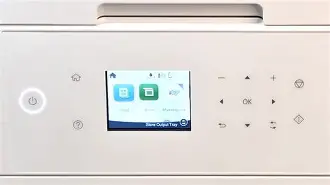
Photo Printing Capabilities
While the ET-3950 is not marketed as a dedicated photo printer (unlike the EcoTank Photo models), it performs admirably on glossy media. For family photos or internal creative mockups, the detail is high and the colors are accurate. However, because it uses a standard four-color CMYK array rather than the six-color systems found in photo-centric machines, professional photographers might find the color depth in shadows slightly lacking. For the average user, it eliminates the need for a trip to a photo lab for standard 4x6 or 8x10 prints.
Scanning and Copying Functionality
The scanning resolution is 1200 x 2400 dpi, which is standard for this tier. During the month, the scanner was used for archiving old documents and digitizing receipts. The "Scan to Cloud" feature is particularly useful, allowing the printer to send documents directly to services like Google Drive or Dropbox without needing a computer as an intermediary. The ADF is reliable for standard paper weights, but very thin or carbonless copy paper should be fed through the flatbed to avoid jams.
Copying is straightforward, with the color screen allowing for easy adjustment of quantity and magnification. The copy speed for color documents is roughly 5 ppm, which is sufficient for occasional tasks but might feel slow for someone needing to duplicate a 50-page color booklet.
Real-World Economics: The "Tank" Advantage
The most compelling part of the month-long test was watching the ink levels. In a traditional printer, 500 pages of mixed color and text would typically see at least one cartridge hit a "low" warning. With the ET-3950, the ink levels barely moved. Epson claims the included ink bottles can last for up to 6,000 black pages and 7,500 color pages. Based on the volume consumed during the trial, these estimates appear grounded in reality.
When it does come time to buy more ink, the cost per page is a fraction of a cent. Compared to roughly 5 to 10 cents per page for color on a cartridge system, the savings are astronomical for anyone printing more than 50 pages a month. This "unlimited" feeling changes how one uses the printer; there was no hesitation to print long research papers or full-color classroom materials for children, tasks that are often avoided on expensive cartridge machines.
Comparison Table: ET-3950 vs. Competitor Classes
| Feature | Epson EcoTank ET-3950 | Standard Cartridge Inkjet | Entry-Level Color Laser |
|---|---|---|---|
| Initial Cost | Medium-High | Low | Medium-High |
| Cost Per Page (Color) | < 1 Cent | 10-15 Cents | 12-20 Cents |
| Ink Capacity | Very High (Bottles) | Low (Cartridges) | Medium (Toner) |
| Print Technology | PrecisionCore Heat-Free | Thermal Inkjet | Laser/LED (Heat-based) |
| Power Consumption | Low | Low | High |
| Photo Quality | Good | Good to Excellent | Poor to Average |
Buying Guide: Is the ET-3950 Right for You?
Choosing a printer today requires balancing your expected volume against your budget. Here is how the ET-3950 stacks up for different types of buyers:
Looking for the best Electronics deals on Amazon?
See Deals →The Remote Professional
If you print daily—contracts, shipping labels, marketing drafts—the ET-3950 is an ideal choice. The 250-sheet tray and the ADF provide the "office feel" without the bulky footprint of a copier. The reliability of the PrecisionCore head means you won't deal with dried-out cartridges if you take a week off for vacation.
The Student or Educator
Students often need to print hundreds of pages of readings, while teachers are constantly creating handouts. For this demographic, the ET-3950 pays for itself in less than a year through ink savings alone. The ability to print in full color without worrying about the cost is a massive psychological and financial relief.
The Occasional User
If you only print once every two months, a high-capacity tank printer might be overkill. While the ET-3950 handles inactivity better than many older inkjets, the high upfront cost is harder to justify if you never get through the first set of ink bottles. In this case, a very inexpensive cartridge model or a basic monochrome laser might suffice.
Pros and Cons
- Pro: Incredible Ink Economy — The cost savings are the primary reason to buy this machine. Replacing ink feels like a minor expense rather than a major investment.
- Pro: Environmental Footprint — By eliminating plastic cartridges, the amount of landfill waste generated is significantly reduced.
- Pro: Paper Handling — The 250-sheet front tray is superior to the "L-shaped" paper paths of cheaper models, reducing dust and jams.
- Pro: Versatile Connectivity — Excellent app support and reliable Wi-Fi makes printing from phones and tablets effortless.
- Con: Lack of Dual-Scan ADF — While it prints on both sides, it cannot scan both sides of a page automatically via the feeder.
- Con: Upfront Price — The initial cost is high, which can be a barrier for those on a strict budget.
- Con: Non-Touch Interface — At this price point, some users may expect a larger, touch-sensitive screen for a more modern experience.
Maintenance and Long-Term Reliability
One concern often raised about tank printers is the potential for the ink to dry in the lines. During the one-month test, the printer was left idle for five days at several points. Upon returning, the first page was perfectly clear with no clogged nozzles. Epson’s Heat-Free technology seems to contribute to this stability. The maintenance box (which collects waste ink during cleaning cycles) is also user-replaceable, which is a significant "pro" for longevity, as it prevents the printer from becoming a brick once the internal sponges are full.
The EcoTank system also feels more robust than the flimsy entry-level printers sold at big-box retailers. The hinges on the scanner bed and the paper guides in the tray feel designed to withstand the rigors of a multi-user household. It lacks the "disposable" feel that has plagued the inkjet industry for years.
Conclusion
After a full month of testing the Epson EcoTank ET-3950, the verdict is clear: it is a workhorse that successfully bridges the gap between home convenience and professional-grade performance. While the initial investment is higher than traditional printers, the freedom from the "cartridge trap" provides both financial and environmental benefits that are hard to ignore. The print quality is excellent for business and educational purposes, and the physical design is thoughtful and efficient.
If you are tired of the frustration of buying expensive ink every few months and need a reliable device that handles text, graphics, and scans with equal ease, the ET-3950 is one of the best investments you can make for your workspace. It delivers on its promise of low-cost, high-volume printing without requiring the user to compromise on features like auto-duplexing or high-speed connectivity. For the modern home office, it is an essential tool that eventually pays for itself, leaving the user to focus on their work rather than their ink levels.